PATMO Course / Lecture 2 of 7

In this lecture, we use the Chapman cycle as the first example of a reaction network. The goal is simple: understand the four equations, then learn where to find the rate information needed by a model.

Chapman Cycle

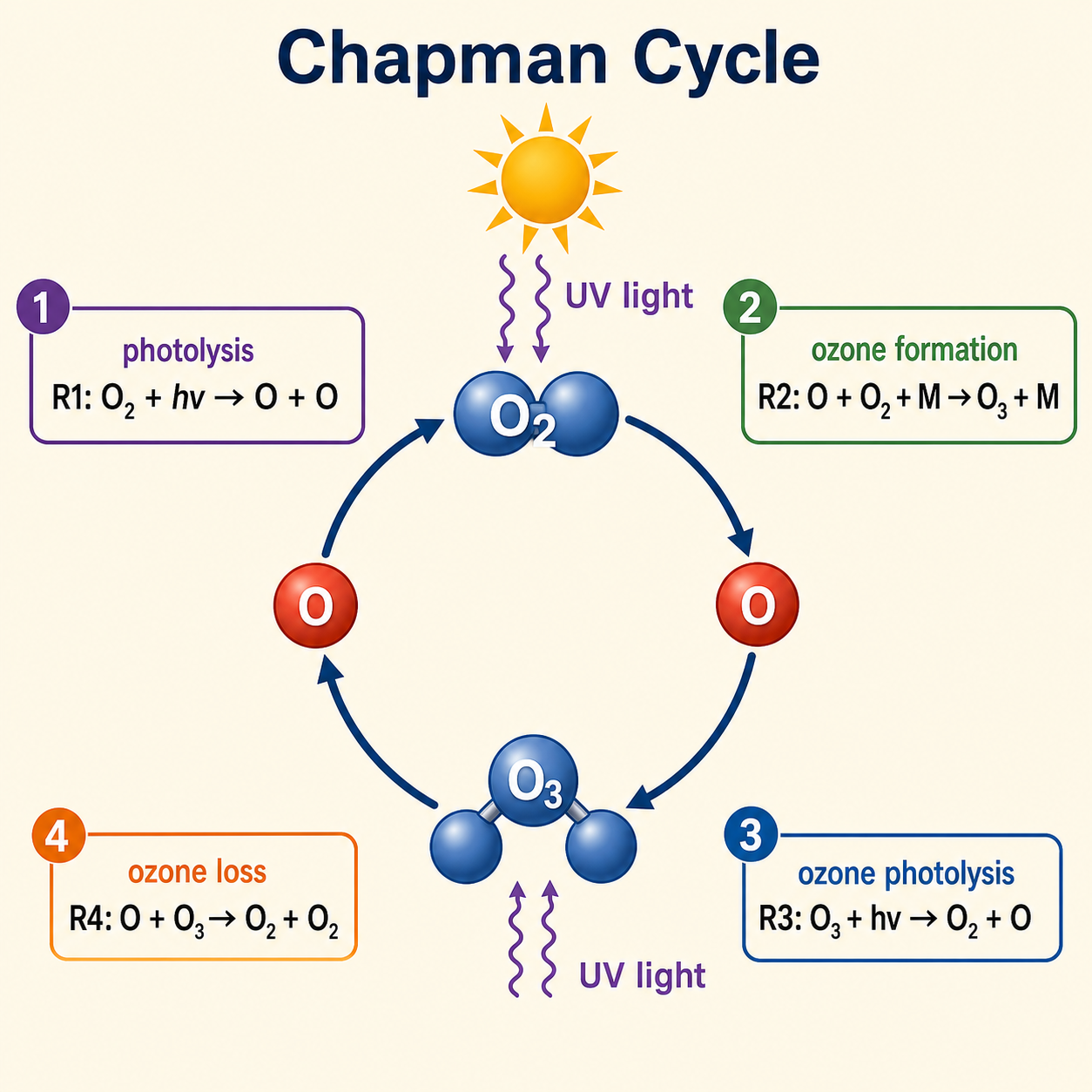
The Chapman cycle is a simple oxygen-only mechanism for explaining the basic formation and destruction of stratospheric ozone. It contains two photolysis reactions driven by light and two thermal reactions controlled by rate constants.

Schematic diagram of the Chapman cycle showing oxygen photolysis, ozone formation, ozone photolysis, and ozone loss.
R1: O2 + hv -> O + O
R2: O + O2 + M -> O3 + M
R3: O3 + hv -> O2 + O
R4: O + O3 -> O2 + O2

Here hv means a photon, and M means a third body molecule such as N2 or O2. The third body is not consumed. It removes excess energy so that newly formed O3 can become stable.

Equation By Equation

R1: Oxygen Photolysis

O2 + hv -> O + O

Ultraviolet light breaks molecular oxygen into two oxygen atoms. This is the starting source of reactive atomic oxygen in the Chapman cycle.

Because this reaction is driven by light, its rate is written as J1[O2]. The photolysis rate J1 has units of s-1.

R2: Ozone Formation

O + O2 + M -> O3 + M

Atomic oxygen combines with molecular oxygen to form ozone. The third body M carries away excess energy.

This is a termolecular reaction. Its rate is usually written as k2[O][O2][M], so the rate constant has units of cm6 molecule-2 s-1.

R3: Ozone Photolysis

O3 + hv -> O2 + O

Ozone absorbs light and breaks back into molecular oxygen and atomic oxygen. In a more detailed mechanism, the oxygen atom may be separated into different electronic states, such as O(3P) and O(1D).

This is also a photolysis reaction, so its rate is written as J3[O3].

R4: Ozone Loss

O + O3 -> O2 + O2

Atomic oxygen reacts with ozone and destroys it. This reaction closes the oxygen-only ozone cycle.

This is a bimolecular thermal reaction. Its rate is written as k4[O][O3], and k4 usually has units of cm3 molecule-1 s-1.

From Equations To A Network

A reaction network is the model-ready version of these equations. For each reaction, the model needs the equation, the rate law, the kinetic parameter, the unit, and the source.

ID Reaction Type Rate term What to look up
R1 O2 + hv -> O + O photolysis J1[O2] photolysis data for O2
R2 O + O2 + M -> O3 + M termolecular k2[O][O2][M] temperature and pressure dependent k2
R3 O3 + hv -> O2 + O photolysis J3[O3] photolysis data for O3
R4 O + O3 -> O2 + O2 bimolecular k4[O][O3] temperature dependent k4

One Worked Database Example

We will only demonstrate the database workflow with one reaction:

O + O3 -> O2 + O2

The remaining Chapman reactions should be found by students using the same method.

Step 1: Search JPL

Open the JPL Data Evaluation. Search the latest evaluation PDF for O + O3, O3 + O, or O(3P) + O3.

JPL is the first stop because it gives evaluated recommendations for atmospheric modeling.

Step 2: Record The JPL Entry

For this reaction, a common evaluated expression is:

k(T) = 8.0e-12 exp(-2060/T)

Record the units cm3 molecule-1 s-1, the temperature range, and the JPL note number.

Step 3: Search NIST

Open the NIST Chemical Kinetics Database. Search for the same reactants and products.

NIST is useful for checking the literature records behind the reaction.

Step 4: Compare

Compare the NIST records with the JPL recommendation. Pay attention to temperature range, reaction order, data type, authors, and year.

If you use the value in a model, cite the database and keep the original literature trail.
Do not copy only the number. Copy the reaction, rate expression, units, temperature range, database name, evaluation or record information, and citation notes.

After-Class Task

In class, we demonstrated the database workflow with one non-photochemical reaction: O + O3 -> O2 + O2. Your task is to complete the remaining non-photochemical Chapman reaction and then build the PATMO input reaction network.

  1. Use JPL and NIST to find the k value for O + O2 + M -> O3 + M.
  2. Record the rate expression, units, temperature range, pressure or third-body notes, and database source.
  3. Prepare the complete Chapman reaction network in the PATMO input file format used in class.
  4. Include all four Chapman reactions in the network, but only the two non-photochemical reactions need thermal k values.
  5. Add short source notes so another student can trace where each non-photochemical k value came from.

Submit the PATMO reaction network input file, not only a summary table. The file should be ready for the next class discussion.